Home > Columns > CRM Columns
2026: The Year of CX AI Payback

In November and December 2025, DMG Consulting conducted its
annual worldwide survey of enterprise customer experience (CX) AI goals and
investment priorities to discern what enterprises are planning for 2026. Now in
its twelfth year, the study provides one of the industry’s longest‑running
views into how contact center and CX priorities are evolving. This year’s
findings, confirming that contact centers have made AI the strategic
cornerstone of CX transformation in 2026, are supported by the top CX goals: contact
center modernization, operational efficiency, improved reporting/analytics and
insights, expanded self-service, and enhanced data quality. Enterprises plan to
advance these objectives through investments in AI infrastructure and
orchestration, analytics, and other CX technologies. Notably, and in contrast
to 2025 and prior years, organizations are placing greater emphasis on
measuring and quantifying the impact of their CX AI investments to ensure they
achieve the expected return on investment (ROI).
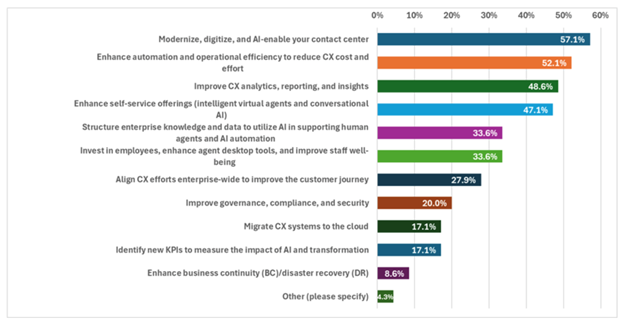
2026 CX AI Strategic Goals and Investment Priorities
Source: DMG Consulting LLC, January 2026
This figure shows the 11 top responses to the
question: Which of these strategic goals and investment priorities are on
your 2026 roadmap? Survey participants were asked to select their top five
answers to this question. The leading priority, chosen by 57.1% of respondents,
was to modernize, digitize, and AI-enable the contact center. While not
surprising, it marks the first time in 11 years that delivering a great CX was
not the top enterprise CX goal, signaling that organizations are moving beyond
rhetoric and taking decisive action to achieve this objective. The second most
selected answer, cited by 52.1% of respondents, was enhancing automation and
operational efficiency to reduce CX cost and effort. Together, the top two
responses reflect a market shift toward initiatives that deliver quantifiable
and measurable outcomes and business value. The third-ranked priority,
improving CX analytics, reporting, and insights, was selected by 48.6% of
survey participants, highlighting the growing demand for better data to support
AI-enabled solutions. While this goal has appeared consistently in past
surveys, its high placement reinforces its growing importance to organizations.
In the AI era, CX functions require new key performance indicators (KPIs) that
provide the insights and information CX leaders need to deliver an effective,
personalized, and differentiated CX.
In the second tier of responses, enhancing self-service
offerings – such as intelligent virtual agents (IVAs) and conversational AI
(CAI) – ranked fourth, selected by 47.1% of respondents. Two priorities tied
for fifth place at 33.6% each: structuring enterprise knowledge and data to
utilize AI in supporting human agents and AI automation, and investing in
employees, enhancing agent desktop tools, and improving staff well-being. These
two priorities are interrelated, as clean and well-organized knowledge and data
are essential for effective AI-enabled agent augmentation tools. The final goal
in this tier, selected by 27.9% of respondents, was aligning efforts
enterprise-wide to improve the customer journey. AI and analytics are giving
organizations better insights into the customer end-to-end journey, an
objective that has eluded them for decades. This visibility is necessary to
gain an appreciation for how customers are treated throughout the enterprise,
not just within the contact center.
In the next tier of responses, improving governance,
compliance, and security ranked seventh, selected by 20% of participants. Two
priorities tied for eighth place at 17.1% each: migrating CX systems to the
cloud, and identifying new KPIs to measure the impact of AI transformation.
While these goals fall lower on the list, they remain essential as
organizations work to modernize their operations with AI and automation.
Enhancing business continuity (BC)/disaster recovery (DR) ranked last, with
8.6% of the responses, followed by the “other” category. Although BC/DR is a
requirement for contact centers, it consistently appears at the bottom of the
priority list as contact center leaders focus their budgets on higher-impact
initiatives.
Final Thoughts
The findings from DMG’s 2026 survey show that the CX
industry has reached an inflection point. After the past couple of years of AI
pilots and proofs‑of‑concept, enterprises are ready to move forward with
implementations, but they are requiring vendors to commit to measurable results
and ROI from their investments. The top strategic goal for 2026—modernizing,
digitizing, and AI‑enabling the contact center—signals a shift from broad AI
aspirations to specific tactics and technologies that deliver measurable outcomes.
As AI capabilities mature, organizations will apply them to increasingly
sophisticated tasks, but widespread adoption will depend on the technology’s
ability to deliver sustained, quantifiable business benefits.
Companies have ambitious plans for AI in 2026, and the data
indicates they are going to move beyond pilots into full‑scale deployment.
Despite ongoing concerns around AI cost, data readiness, and operational
maturity, enterprises are planning to invest in the infrastructure,
orchestration platforms, data‑quality initiatives, and governance frameworks
needed for AI to be effective. In 2026, DMG expects enterprises to move from
aspiration to disciplined execution of AI-enabled CX applications.
The column and chart are based on the survey findings in
DMG’s CX AI Playbook: Strategic Outlook and Investment Priorities. Click here to obtain the full report.